Thoughts on Nolan's "The Odyssey"
I saw The Odyssey very recently. I was about 3/4 of the way through Emily Wilson’s translation before watching the movie and I finished reading it a few days afterwards. I had a lot of fun with both. But I do have some thoughts.
get a feeling so πολύτροπος
Considering how much I loved the movie, it’s weird how most of this review is complaint. Sitting in that movie theatre seat, I was spellbound. It was the most packed viewing I’ve been to in a while, and it was weekday matinée. But the more time I’ve spent thinking about the movie, the more its luster disappears. I guess what I’m trying to say is the ways in which Nolan’s Odyssey is good are standard, but the ways in which it’s bad are much more unique. Maybe that’s why the good qualities, as genuinely good as they are, stand out less.
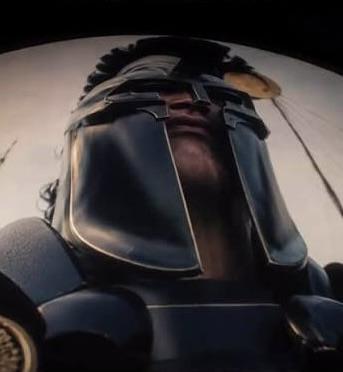
The score is incredible. Ludwig Göransson cooks once again. Pacing has improved since Oppenheimer (and I’ll get back to that movie later). The acting is all good, but without any stand-out role. The action was very nice, as were the special effects. I loved specific scenes like the Cyclops sequence. I liked looking at Agamemnon.1
Regarding the movie’s positive qualities, that’s all I have to say. I had issues with everything else.
Everything Else
The cast was too famous, their faces too familiar (like a certain other Nolan flick). It’s hard to slip into the world when you already know Telemachus is married to Athena. And I’ve never been a fan of Nolan’s dialog. It always felt flat and too literal. There isn’t enough character in his words, any role can say any sentence. There’s many attempts at wit but no actual wit to be found. I also take issue with his editing. The erratic cutting works for intense sequences, but if it’s two characters chatting we do not need that many cuts or close-ups. Why do some shots last for less than a heartbeat? And stop cutting to the exact scene/moment that characters are referring to. How many times do we have to see Antinous dodge the draft? We aren’t goldfish.
Aesthetically the movie is very confusing. Some things feel Greek, maybe too Greek. But a lot doesn’t. And I get that Odysseus travels to foreign lands, but does he also travel across time? It all feels very pastiche. The only uniting factor about the aesthetic is that everything looks old.2 But that’s not exactly a desirable outcome either. Telemachus and Penelope are living in already ancient ruins. And yes, it’s ancient to us, but it shouldn’t be to them. So everything feels like it’s “made to be old” instead of simply being old, or just being.3
AND YET…
…the film is also painfully modern. There’s the aforementioned celebrity problem, but thematically it’s very modern as well. I couldn’t help but notice how godless this Odyssey was. Yes, there’s Athena, but only Odysseus sees her, she doesn’t use any divine powers, and near the end it’s revealed that she had taken the form of a temple priestess who Odysseus’s men killed in the sacking of Troy. And this is the only “god” present. The rest of the pantheon exist in name only, in stark contrast with the epic poem. There’s even a moment early in the movie where Telemachus tells Mentor “You have wise eyes…Athena’s4 eyes,” as if feeling him out. But unlike the text, where Mentor at this point is Athena in disguise, movie Mentor replies, “Stop trying to see gods in men.”
It’s also worth noting that all the mythological monsters and bizarre happenings that Odysseus encounters are from the perspective of a shipwrecked amnesiac regaining his memory. Everything after leaving Calypso’s island is grounded in reality. Poseidon does not threaten Phaeacia with a mountain; that part is entirely skipped. Athena does not help disguise Odysseus; he just wears a tattered cloak. We don’t even see any omens; just thunder rumbling before the suitors’ demise. It’s a world where myths are dying, and Odysseus killed the most important myth of all: Zeus’s Law. There’s a Nietzschean angle there; Zeus’s Law is just The Golden Rule, fueled by the belief that any stranger could be a god in disguise. No Zeus, no Law. At first I thought this was interesting. Admittedly it kinda is. But it’s also recycled.
Tell me about a duplicated man.
A mournful man spurred by war, led by forces greater than himself to indirectly commit atrocities through his intellect, bringing about a metaphorical/not-so-metaphorical end of the world? You’ve heard of the American Prometheus, now get ready for the Greek Oppenheimer! The role was previously played by Cillian Murphy, and now it goes to Matt Damon. So who plays Odysseus?
Nobody.5
(No pun intended.)
Where is wily Odysseus, cunning Odysseus, the lord of lies, the master of manipulation, Mr. polytropos himself? Nowhere to be found. That bow-plucking thing that he does “for honor”? Real cute. It’s even based on the text.6 But am I to believe a trickster cares that much about honor? We don’t even get the “Nobody” trick with Polyphemus, which is arguably Odysseus’s greatest bit yet.
The last thing I’ll say is that this movie is strangely transparent. Once you read the original text, you can see how it got “movie-fied” by Nolan.7 Emphasize this, cut back on that. Add this thematically relevant backstory, shove in this moral. And that kinda reveals the structure movies tend to have.
If I were more cynical, I’d say that this is as faithful an adaptation of The Odyssey as Joyce’s Ulysses. But I haven’t read that one yet, so I wouldn’t know. If I were to put all of my thoughts into a single concise phrase, it’d be this: this was a pretty good movie but a pretty bad Odyssey.
𓇼 ⋆.˚ 𓆉 𓆝 𓆡⋆.˚ 𓇼
-
Note how it doesn’t feel old. ↩
-
This is the exact opposite of Wilson’s approach to translating the text. ↩
-
How romantic of you, Telemachus. ↩
-
Or “Noman,” from Wilson’s translation. ↩
-
Odysseus does this right before shooting the arrow through8 twelve axes and going Doom: Eternal on the suitors. ↩
-
Eumaeus did not have nearly as much relevance or “aura” in the original. ↩
-
I still don’t get that. What you mean “through” twelve axes? Every adaptation I’ve seen does it differently. Sometimes the axes have little rings on the end, sometimes the axes are tied together into pairs with a gap between them (Nolan’s choice), sometimes the axes just have holes in them. Wilson suggests the poem really means axe-heads, and the holes are where the wooden handle usually is. Gotta say, it didn’t look that hard in the Nolan movie. Those were some large gaps between the pairs of axes. ↩